01 · Use
How the Space Works
What happens inside the building day to day? Vehicle flow, racking, lifts, staging, customer areas — the operation defines the structure.
Resources
Plain-English information for business owners planning a steel building — what to prepare, what moves the price, and what the industry terms actually mean.
Before You Request a Quote
You don’t need final answers to start — but thinking through these six items makes your first conversation dramatically more productive.
01 · Use
What happens inside the building day to day? Vehicle flow, racking, lifts, staging, customer areas — the operation defines the structure.
02 · Size
A rough width × length target and how tall the interior needs to be at the eave. Ranges are fine; precision comes later.
03 · Site
The site’s ZIP code drives code requirements, wind and snow loads, and logistics. If you have a specific parcel, even better.
04 · Openings
How do vehicles, equipment, and people enter? Drive-in doors, dock positions, personnel doors, and storefront glazing shape the design.
05 · Timeline
An honest target date lets the process be planned backward from your operating calendar instead of guessed forward.
06 · Growth
If expansion is even a possibility, say so now. Frame lines and site layout planned for phase two cost far less than retrofits.
Cost Drivers
Size and clear-span requirements, local code and load conditions, openings and glazing, finish level, site factors, and optional add-ons. Not marketing — engineering.
The full breakdown lives on the Process page, and every Drywizard quote identifies which factors apply to your specific project.
See the Cost Factors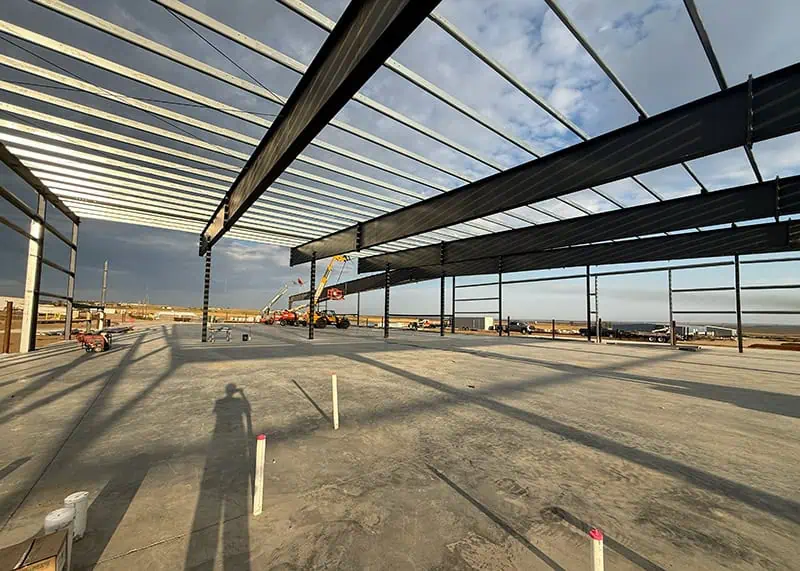 Steel frame erection
Glossary
The vocabulary you’ll see in quotes, drawings, and conversations — defined the way a buyer needs them, not the way an engineer would write them.
Structure
Pre-Engineered Metal Building. A steel structure engineered and fabricated as a system — frames, secondary members, and panels designed together for your loads and code.
Structure
The rigid frame cross-section of the building — two columns and a rafter. It’s the shape in our logo, and the skeleton your building repeats down its length.
Structure
Interior space with no support columns. Critical for service bays, racking layouts, and any operation where columns get in the way.
Dimensions
The height from the floor to where the roof meets the wall. Determines lift clearance, racking height, and door sizes.
Dimensions
The distance between main frames along the building’s length. Affects layout flexibility and where openings can go.
Structure
The secondary horizontal members that carry roof panels (purlins) and wall panels (girts) between the main frames.
Loads
The wind, snow, seismic, and collateral loads your building is engineered to resist — set by your local code and site, not by preference.
Loads
The weight of everything hung from the structure — sprinklers, HVAC, lighting, cranes. It must be declared up front to be engineered in.
Envelope
The shape and gauge of the wall and roof sheeting. Drives appearance, weather performance, and finish level.
Envelope
A roof system with concealed fasteners and raised seams — a common upgrade for longevity and a cleaner commercial appearance.
Site
The drawing that tells the foundation contractor exactly where the building connects to the concrete. Foundation and building must be coordinated.
Process
The on-site assembly of the steel package. Whether erection is included in your project scope is stated explicitly in the quote.
Bring what you’ve learned to a real conversation about your building.